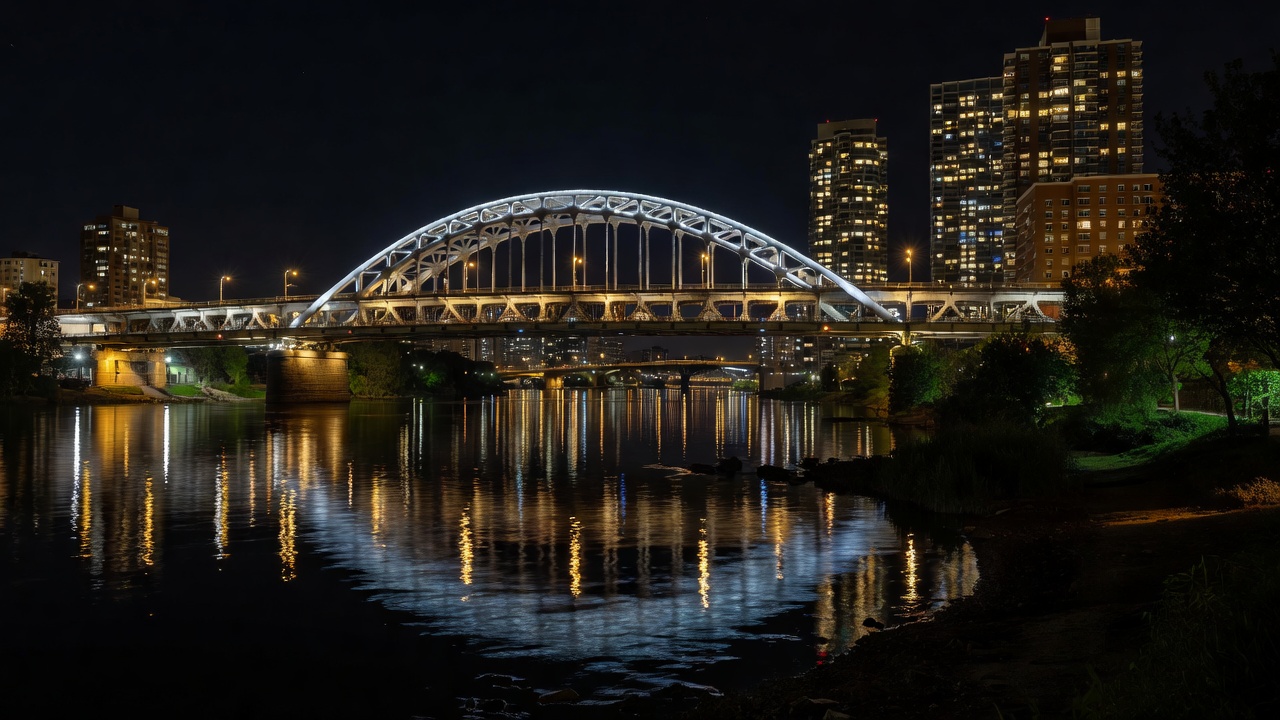
A familiar bridge can help people orient themselves long after shopfronts close and the river disappears into darkness. Its outline may mark a district, a journey home or an important public gathering place. That civic value does not depend on maximum brightness. Often it depends on a consistent, understandable presence. The most useful landmark is one people recognize without having to surrender the comfort of surrounding streets and homes.
Build identity from what is already there
Start with the bridge’s structure, history and ordinary use. The Gateshead Millennium Bridge, the Pont Jacques-Cartier in Montréal and the Peace Bridge in Derry each occupy a different civic setting. The Rialto Bridge and the Ponte Vecchio bring another kind of relationship between crossing, architecture and public memory. These examples invite comparison of context; they do not imply that one city’s lighting approach should be reproduced elsewhere.
Ask residents what they already identify with the crossing. It may be a tower visible from a street, a sequence of arches seen from the river, or a pedestrian route used every day. A scheme built around an imported visual effect can overlook that attachment. Lighting can reveal existing identity more convincingly than it can manufacture a new one through colour alone.
Treat neighbours as an audience
A promotional photograph is usually chosen from a flattering public viewpoint. Residents may see the installation from a bedroom window at a different height and angle. Map those sensitive views early, and use mock-ups to test them. Describe proposed operating hours, ordinary scenes and event exceptions in language people can evaluate. Consultation is more meaningful when the choices are visible and the maintenance and complaint processes are clear.
Not every concern is solved by reducing output globally. A carefully placed shield or a revised aiming angle may address an intrusive view without weakening the whole composition. Other situations require a shorter operating period or a quieter scene. Record concerns by location and time, then test the response. The aim is not to dismiss discomfort because a landmark is popular, nor to assume every objection requires abandoning all architectural lighting.
Keep river habitats in the conversation
Waterways can be important movement and feeding corridors for wildlife. Light falling on the water, banks or vegetation may affect species differently, so a simple claim that one lamp colour is universally wildlife-friendly is inadequate. Obtain competent ecological advice for the specific site. Consider avoiding light in sensitive areas before relying on technical adjustments to reduce its effect.
Useful design questions include where the beam ends, whether the underside of the bridge needs illumination, and which dark connections should remain intact. Spectrum, intensity, direction and duration all matter. A warm appearance alone is not a complete environmental strategy. Guidance from the Bat Conservation Trust and the Institution of Lighting Professionals can inform discussion, but site-specific surveys and applicable permissions remain important.
Respect the fabric as well as the view
On a historic bridge, the installation itself deserves scrutiny in daylight. Cable runs, brackets and equipment cabinets may affect protected fabric or important views even when the lights are off. Discuss attachment methods, reversibility and access with the responsible conservation specialists and asset owner. A visually discreet night-time scheme can still cause an unacceptable physical intervention if its equipment is poorly coordinated.
Think about the surrounding heritage setting too. A brightly emphasized crossing may compete with a quieter civic building or change a long-established river view. Compare the intended hierarchy across the whole scene. The bridge does not need to win every visual contest to remain important. A coherent nightscape can give several landmarks room to be understood.
Make event lighting accountable
Colour changes can mark civic occasions, but they create operational and editorial responsibilities. Who can request a scene? Who approves it? How long does it last? Publish a consistent approach rather than treating every request as an exception. Avoid rapid or distracting effects where they could affect drivers or public comfort. A calm ordinary scene gives occasional changes meaning and makes the return to everyday operation recognizable.
Events also need a technical end point. A temporary override should expire, and essential route lighting should remain independent. Staff should know how to restore the baseline scene without relying on one specialist. The public meaning of a lighting event depends on practical competence as much as on the colours displayed.
Measure success beyond the opening night
Ask what the scheme contributes after the launch: better orientation, a clearer reading of the bridge, a comfortable riverfront and manageable upkeep. Review complaints, failures, energy use and operating hours. Do not assume that increased footfall, improved safety or economic benefit follows automatically from illumination. Those outcomes need appropriate evidence and may depend on many other changes in the area.
A landmark is a long-term public relationship. Its lighting should be capable of adjustment as neighbourhoods, habitats and expectations change. Keeping a reliable asset record, a straightforward reporting route and an agreed review process is less glamorous than a spectacular reveal, but it is what allows a bridge to remain a valued part of the nightscape.