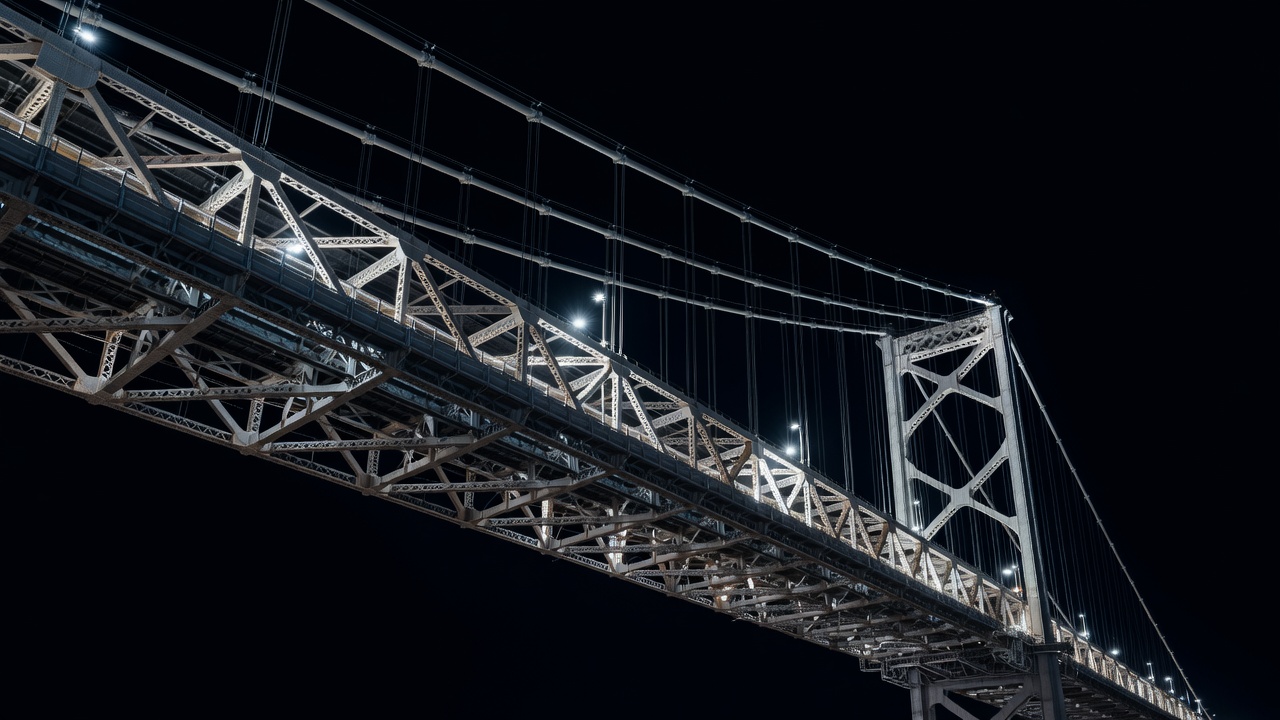
After sunset, a bridge may lose the visual clues that make it understandable by day. Water disappears into shadow, cables become difficult to distinguish, and the deck can seem detached from its supports. Architectural lighting can restore a clear reading, but it can also invent a misleading one. The useful question is not simply which surfaces can receive light. It is which relationships people should still be able to understand.
Choose a hierarchy before a fixture
Begin with one principal idea: the sweep of an arch, the rhythm of a truss, or the relationship between a tower and its stays. Give that idea visual priority. Secondary members can remain quieter, and some surfaces can remain unlit. A scheme in which every member has equal emphasis often becomes a collection of bright lines rather than a coherent structure. Darkness is part of the composition, not evidence that the design is unfinished.
Different structural types reward different approaches. On a suspension bridge, the main cable, towers and deck can establish the overall profile. On a cable-stayed bridge, a selective reading of the fan or harp arrangement may explain the span. An arch may be understood through its curve and springing points. A truss needs enough contrast to distinguish depth without turning every diagonal into a competing graphic.
Design for more than the postcard
The opposite bank is only one audience position. People underneath the structure may see the luminaires directly, while someone on the deck sees reflected light and nearby handrails. Drivers may encounter a bright source at a shallow angle. Establish representative viewpoints early, including residential windows and accessible paths. A night-time mock-up should test the troublesome close view as carefully as the attractive distant one.
Real bridges offer useful exercises in observation. Compare the exposed lattice of the Forth Bridge with the masonry and suspension elements of Tower Bridge. Consider how the Erasmus Bridge’s pylon differs from the broad arch of the Sydney Harbour Bridge. These are examples of distinct forms, not templates for copying a particular installation. Their scale, heritage context, surroundings and operational requirements differ substantially.
Let materials influence the light
Painted steel, weathered stone and concrete do not return light in the same way. Surface texture, colour and moisture affect the result. Grazing light can reveal relief but also exaggerate repairs, joints and staining. Wet surfaces may introduce reflected highlights absent during a dry mock-up. Test a representative area with the intended mounting position and shielding rather than relying only on a polished rendering or a fixture’s catalogue image.
Colour can support a structural hierarchy, but it can also erase it. When several saturated colours compete, a clear load-bearing pattern may become harder to follow. A restrained everyday scene can establish a recognizable baseline, with any special-event scene treated as a separate, limited operation. The bridge should remain readable when that event finishes and the familiar scene returns.
Make maintenance part of the composition
A line of light is only as continuous as its least reliable connection. Consider how a failed fitting, uneven replacement or dirty lens will affect the intended pattern. Drivers, connectors, cable routes and controls need appropriate environmental protection and safe access. Installation must be coordinated with the bridge owner and competent engineers; fixing equipment to a structural member is not a purely visual decision.
Access can determine the design more strongly than appearance. A fitting that requires a road closure or specialist rope access for routine work carries a different maintenance burden from one reachable from an approved service position. Specify replaceable parts where feasible, record aiming settings, and keep an asset schedule. An elegant scheme that cannot be maintained will gradually become a different, less legible scheme.
Judge the result from public space
Return after commissioning and ask whether the structure is clearer, not merely brighter. Can people still see the route? Do reflections obscure the water’s edge? Does a residential viewpoint reveal unintended glare? Record the ordinary operating scene as well as the ceremonial one. The best structural lighting gives people a lasting explanation of the bridge while leaving room for darkness, daily use and practical care.