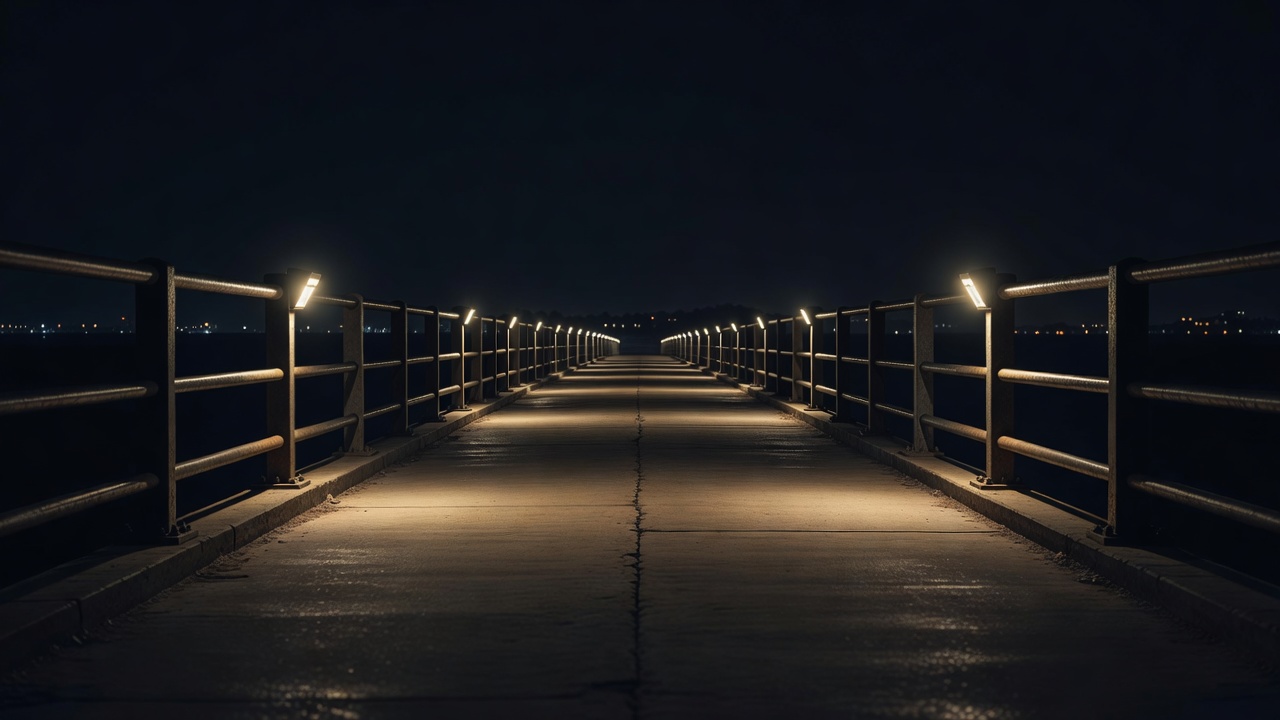
From a distance, a bridge can appear brilliantly illuminated while its walking route remains difficult to understand. The decorative scheme may face outward toward a riverbank, leaving the approach in shadow. A bright handrail can attract attention without revealing a change in level. Good visibility begins by separating the public task of crossing from the visual task of celebrating the structure. Both can coexist, but one cannot stand in for the other.
Begin before the bridge
Follow the whole journey from the adjacent street or path. Can someone identify the entrance, choose the correct route and see where it continues at the other end? Consider ramps, steps, junctions and changes in surface material. A well-lit central span cannot repair a confusing approach. Lighting should work with signs, tactile information, barriers and the physical arrangement of the route rather than trying to compensate for every other design weakness.
Walk in both directions because the view changes. A fitting that is comfortable on the outward journey may be visible directly on the return. Check from seated as well as standing eye heights where practical, and invite people with different access needs into the review. Do not enter restricted areas, stop in traffic or lean beyond barriers to obtain a viewpoint. Ordinary public positions are the relevant starting point.
More light can mean less information
Glare is not simply an unpleasant sensation. A bright source in the field of view can make surrounding detail harder to see. On a dark riverside route, exposed LEDs or an incorrectly aimed floodlight may dominate the scene. Adding more output to the pavement may not solve that problem. Shielding, optical control, mounting position and a more balanced distribution can be more useful than increasing the total amount of light.
The transition between bright and dark areas matters too. People need to look beyond the pool of light immediately around them. Very bright patches followed by deep shadows can make the next part of a route less readable. Observe whether faces, edges and obstacles remain distinguishable along the journey, not just directly beneath a fitting. A photograph with a long exposure may conceal precisely the difficulty a pedestrian experiences.
A practical visibility check
- Identify the route and its continuation.
- Look for steps, surface changes and ambiguous edges.
- Check direct views of light sources in both directions.
- Compare dry and wet conditions where safely possible.
- Record the location, direction and ordinary operating scene.
Think beyond the horizontal surface
Illuminance on the walking plane is one part of a much larger picture. Vertical surfaces, the visibility of other people and the contrast of objects against their background also matter. A route can meet a numerical target at selected points and still feel visually confusing. Conversely, a carefully controlled distribution can make a modest amount of light useful. A competent lighting professional should assess the relevant criteria and the actual context together.
Wet paving, polished metal and water introduce reflections that change the view. A luminous stripe reflected in a wet deck can appear much brighter than expected, while a dark object against that reflection may be difficult to distinguish. Winter vegetation, temporary signs and maintenance barriers also alter the scene. Review more than one condition and do not treat a single dry evening as proof of year-round performance.
Use standards as a framework, not a slogan
The EN 13201 road-lighting series addresses the performance and assessment of road lighting, while CEN/TR 13201-1 provides guidance on selecting lighting classes. The appropriate application depends on the route and jurisdiction. CIE 115 discusses road lighting for motor and pedestrian traffic. These documents are technical resources, not a reason to quote one universal brightness value for every bridge, path and public space.
Obtrusive light requires its own attention. CIE 150 provides guidance on limiting its effects, and the Institution of Lighting Professionals publishes guidance on the reduction of obtrusive light. Local planning conditions and statutory requirements may impose additional constraints. A public observation can identify concerns, but it does not replace a professional survey, a compliant design or the bridge owner’s safety responsibilities.
Record a concern so someone can act
A useful report describes a specific experience: the north approach, facing toward the deck, with a bright fitting visible above the handrail. Include the date, approximate time, weather and whether the lighting appeared to be in an event scene. Avoid concluding that a route is safe or unsafe solely from brightness. Safety has many contributors, including maintenance, sightlines, traffic and patterns of public use.
If a light is damaged or a crossing presents an immediate hazard, contact the responsible authority through its official reporting or emergency channels. This publication does not operate bridges or handle urgent faults. For a general design question, our local message tool can help you organize observations without uploading them. Clear descriptions make conversations about the nightscape more productive than a request to make everything brighter.