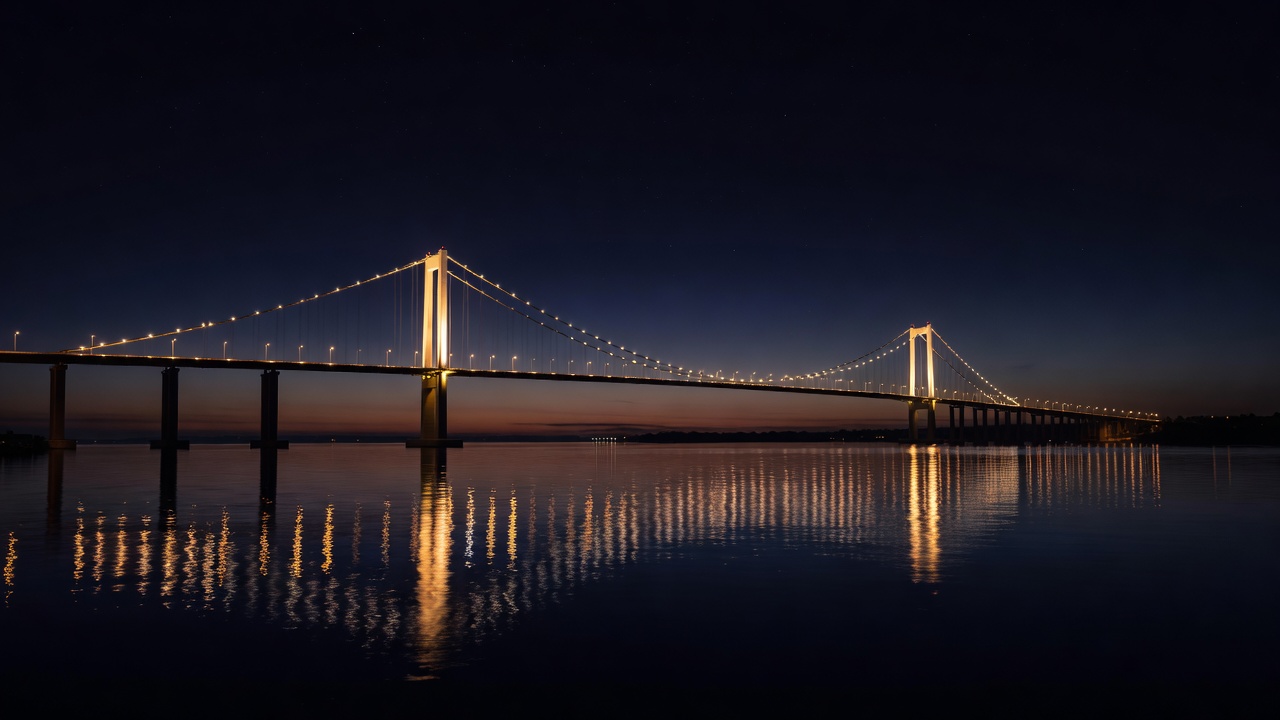
A resident looking from a window experiences a lighting schedule as directly as a designer experiences a colour palette. A bridge that feels lively early in the evening may feel intrusive after surrounding streets become quiet. Controls turn that changing context into an operating plan. Their purpose is not simply to animate a landmark. It is to provide the light needed for each use, avoid unnecessary output and make everyday operation understandable.
Separate essential and decorative layers
Start by identifying what each circuit actually does. Lighting for a pedestrian route, road traffic, maintenance access or navigation may have requirements that decorative tower lighting does not share. Those functions should not depend on a single show controller or an event scene. Agree the operational boundaries with the bridge owner, highway authority and other relevant bodies. A decorative curfew must never inadvertently remove required visibility or a statutory navigation signal.
Document the distinction in plain language as well as technical drawings. An operator should be able to identify “footway,” “structural outline” and “special event” without guessing at obscure channel names. Clear naming helps maintenance teams isolate problems and prevents a later adjustment from changing an unrelated part of the installation. It also makes discussions with residents more precise: a complaint about a tower floodlight need not become a debate about switching off the crossing.
Write the evening as a sequence
A typical sequence might establish an ordinary scene at dusk, reduce decorative intensity later and switch off selected layers at an agreed curfew. This is an example of a method, not a universal timetable. Local use, ecology, heritage conditions and the surrounding nightscape should determine the actual settings. Seasonal changes matter too: a fixed clock time may relate very differently to sunset in winter and summer.
Confirm dusk conditions.
Use the ordinary scene.
Apply agreed dimming.
Stop decorative output.
Astronomical time clocks calculate switching events from location and date. Photocells respond to measured ambient light. Either approach needs sensible commissioning, correct settings and a plan for faults. A poorly placed sensor may see a nearby luminaire rather than the sky. A controller with the wrong location, time zone or clock setting can create a persistent error that looks like a design decision to everyone outside.
Choose protocols for the job
DALI, including equipment certified through the DALI Alliance’s DALI-2 programme, is commonly associated with addressable lighting control and feedback. DMX512 is widely used for fast scene and entertainment-style control. Network transport such as sACN may connect a larger system. These names do not guarantee reliability, interoperability across every product, or a particular visual result. Specify the required behaviour, then verify that the complete system can deliver it.
| Need | Useful question | Operational consequence |
|---|---|---|
| Ordinary dimming | Can each layer follow its own schedule? | Reduces unnecessary decorative output. |
| Event scenes | Who approves and ends an override? | Prevents a temporary scene becoming permanent. |
| Fault reporting | What failure can the system actually detect? | Avoids false confidence in remote monitoring. |
| Network loss | What local fallback remains available? | Keeps operation predictable. |
Decide what happens when things fail
A broken connection should not leave the installation flickering through uncertain states. Define the response to lost data, failed controllers, power interruption and clock errors. Depending on the function, the appropriate response may be a stable local scene or decorative lighting switched off. The essential point is that the response is deliberate, documented and tested. A networked controller should also have appropriate access restrictions and a clear owner responsible for updates and credentials.
Manual overrides need an expiry. Without one, a maintenance test or civic event can unintentionally run for weeks. Keep a record of changes, retain a known baseline configuration and provide staff with a practical recovery procedure. Where remote access is available, do not assume every adjustment needs to be made remotely; a safely accessible local control can be valuable when communications fail.
Commission the behaviour, not just the picture
Watch the transitions in person. A technically smooth fade can still be distracting when seen from a home across the water. Check minimum dimming levels, colour consistency, restart behaviour and the return from an event to the ordinary scene. Confirm that the installation follows its schedule over several nights, rather than approving it only during a supervised demonstration with every specialist present.
Finally, connect controls to an ongoing review. Energy use depends on actual power and operating time, not merely on whether the fixtures contain LEDs. Compare recorded operation with the intended sequence, investigate unexpected hours and revisit complaints. A thoughtful control system allows a bridge to remain recognizable while using less light when less light is enough.